
Two Critical Links for V2G AC: UL 1741 SC and ISO 15118-20 Amendment 1 Recently Published
By Zach Woogen, Executive Director
On May 21, 2026, UL Standards & Engagement released the UL 1741 Supplement SC for AC Bidirectional Electric Vehicle Supply Equipment for EVs with SAE J3072 Bidirectional Onboard Inverters. This long-awaited standard, and the resulting developments now underway, may catalyze a new market for low-cost, scalable vehicle-to-grid alternating current (V2G AC) by supporting interoperability.
Bidirectional electric vehicle (EV) charging solutions are increasingly available in the U.S., with offerings from VGIC members General Motors, Nissan, Ford, and Tesla, and from others, including Rivian, coming soon. Bidirectional EV charging systems that operate in a bidirectional mode when connected to the grid – or “V2G systems,” for the purposes of this post – must move through a utility interconnection process.
Several leading utilities have adopted or proposed updates to their rules to incorporate both vehicle-to-grid direct current (V2G DC) (inverter functions are offboard the EV) and V2G AC (inverter functions are onboard the EV), with VGIC shaping these modifications as part of our effort to align V2G interconnection requirements across the U.S.
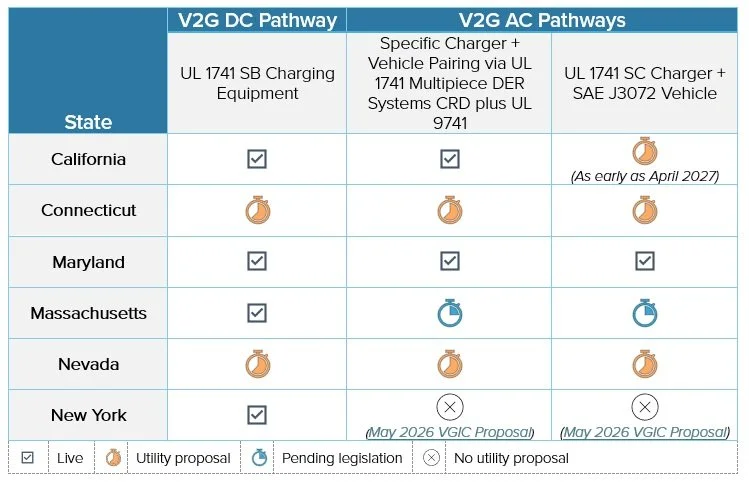
Regulators and utilities in California, Maryland, New York, Massachusetts, and Connecticut have clarified the treatment for V2G DC systems under existing or slightly modified interconnection rules. For some utilities and states, clarity or modifications may not be needed at all, such as when the generic grid interconnection rules reference the core UL 1741 and IEEE 1547 requirements, rather than specific supplements or editions.
As for V2G AC systems, utility rules in California and Maryland explicitly define a certification pathway under the relevant UL 1741 Certification Requirement Decision (CRD) for multipiece distributed energy resource (DER) systems in combination with UL 9741. This approach applies to matched, multipiece DER systems, where a specific vehicle model and charger are certified for V2G AC operation using existing published requirements. Utilities in Nevada and Connecticut have pending proposals to establish this same certification pathway. As stated above, certain utility or state rules may already allow for this without further clarification.
The May 2026 publication of UL 1741 SC offers a new certification pathway for V2G AC systems. The standard supports the interconnection of a charger as an “oversight supervisor” for a vehicle designed and tested to meet SAE J3072. Because this certification pathway does not rely on certifying a given vehicle-charger pair as a single system, industry stakeholders view it as a key step toward widespread interoperability of AC bidirectional charging. Notably, the UL 1741 SC and SAE J3072 ecosystem is expected to support Bidirectional Power Transfer via ISO 15118-20 Amendment 1, which was published on July 13, 2026. Together, this certification pathway and interoperability ecosystem will likely create more options for consumers, as multiple EVs can be configured to interact with a variety of commercially available bidirectional AC chargers.
In 2025, Maryland proactively incorporated UL 1741 SC – alongside the UL 1741 Supplement B (SB) CRD pathway for matched-pair systems – into its interconnection rules in anticipation of the standard’s publication. Utility proposals in Nevada and Connecticut, pending regulatory approval, would similarly incorporate both certification options (UL 1741 SC and the UL 1741 Multipiece DER Systems CRD plus UL 9741) for V2G AC customers looking to safely interconnect.
For California, the UL 1741 SC publication triggers a “shot clock” for considering the permanent incorporation of V2G AC standards into the interconnection rules of the three large investor-owned utilities. On July 10, 2026, these three utilities formally notified the California Public Utilities Commission (CPUC) of UL 1741 SC publication. Now, CPUC staff is authorized to reconvene a dormant V2G AC interconnection working group by August 19, 2026. Within eight months of the working group re-convening, the utilities must propose updates to Rule 21 language to accommodate V2G AC systems or, if industry standards are found to be insufficient, continue to offer an interim pathway for V2G AC systems.
REGULATORY ADOPTION OF V2G INTERCONNECTION STANDARDS
Specific actions to clarify or modify interconnection rules to incorporate grid-parallel V2G systems. Grid-parallel V2G systems are currently safely interconnected in several states not listed. Not all U.S. states and utilities require clarifications or modifications.
The work does not stop here, and for many, it’s just beginning. VGIC and its members look forward to collaborating closely with utilities and utility regulators across more states to usher in this new era of V2G adoption, unlocking affordable, flexible energy resources to support the fast-evolving electric grid.
To learn more about how technical standards and utility interconnection rules are shaping the V2G market and join the leaders creating the future of vehicle-grid integration (VGI) through research, education, and advocacy, please reach out to VGIC’s team.