

Today, about 40 GW of energy storage capacity sits in parking lots, fleet depots, driveways, garages, and curbside across North America. Meanwhile, the electric grid is facing increased peak demand at both the bulk system level and in many local distribution grids, including from new EV adoption. When EVs charge immediately upon being plugged in and fail to account for the changing dynamics of the electric power system, the costs of operating the utility grid increase. Energy bills, already at record highs, become even more challenging for customers. By leveraging EVs to support the grid during peak-time overloads, vehicle-grid integration (VGI) strategies unlock today’s commercially available technologies to mitigate the impacts and costs of a fast-changing electric grid. Managing charging schedules and even the flow of power (including from the vehicle battery to the grid) facilitates the transition toward widespread vehicle-grid integration, helping prevent or delay expensive infrastructure upgrades, save consumers money, address intermittency issues, and enhance grid stability.
Why is Vehicle-Grid Integration Important?
Vehicle-grid integration (VGI) can directly achieve five important public policy goals:
-
Switching from internal combustion engine vehicles to electrified transportation can dramatically reduce a vehicle or fleet's total cost of ownership by reducing fuel costs. By optimizing when and where an electric vehicle or fleet charges to take advantage of lower-cost rates or reduce load during a peak grid event, customers can achieve further significant reductions in vehicle or fleet operating costs. Lower total cost of ownership accelerates EV adoption, saving millions in maintenance and fueling costs for passenger vehicle buyers and fleet operators alike. Specifically, VGI strategies make transportation electrification more accessible and affordable by accomplishing the following:
Reduces the total cost of EV ownership by lowering charging costs and offering new revenue streams to vehicle owners and fleet operators.
Creates new customer value propositions beyond mobility when the vehicle is not in use, such as home backup power. This is especially relevant during power outages due to storms or other emergencies.
Unlocks new revenue streams for vehicle manufacturers, thereby improving the business case for scaling new vehicle product design, manufacturing, marketing, and sales.
Leverages modern power-sharing software to deploy more charging ports at locations that would not otherwise have electrical capacity to install the needed charging equipment, including multi-family housing sites, fleet depots, and public fast charging sites in constrained areas of the electrical grid.
-
For the first time in decades, the electric power system is undergoing rapid change. The Energy Information Administration expects record energy demand in 2026 due to the rapid build-out of data centers. Meanwhile, broader electrification at the grid’s edge, including from home heating and cooling and EVs, puts significant strain on many local distribution systems. Together, these dynamics create immense pressure for reliability (i.e., “will the lights stay on?”) and resilience (i.e., “what is our ability to recover when the lights go out?”). The fast-changing reality of maintaining the grid underscores the critical need to use every available tool in the energy planning toolkit. Historically, the grid has met supply crunches by accelerating the construction and interconnection of new large-scale power plants, building new high-voltage transmission lines, and initiating massive, generational investments in utility equipment. However, pursuing these solutions alone will be entirely insufficient to keep up with the unprecedented near-term pace of demand growth.
Tapping into the inherent flexibility of customer resources and latent energy storage capacity at the grid edge offers a faster, more certain, and significantly lower-cost alternative. The over 40 GW of batteries already sitting in our driveways, garages, parking lots, and fleet depots offer the single largest source of flexibility and energy storage capacity to support the evolving power sector. Given the sheer scale of EV deployment, VGI strategies are already playing a central role in managing today’s electric grid challenges, shaping demand through managed charging, mitigating the need for new grid investments through flexible service connections, and shoring up supply through bidirectional charging.
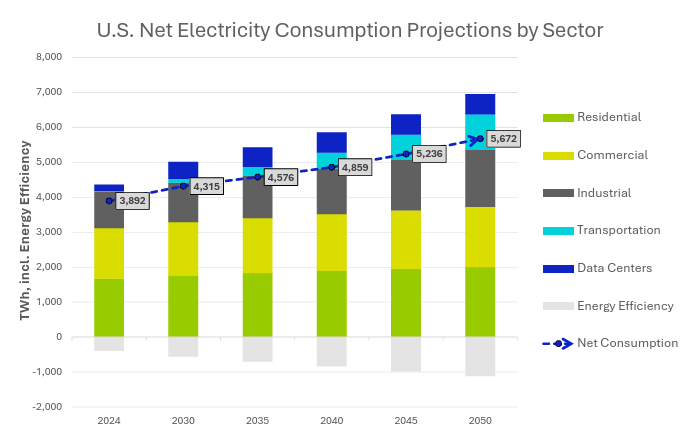
NEMA. (2025). U.S. Net Electricity Consumption Projections by Section. A Reliable Grid for an Electric Future: NEMA’s Grid Reliability Study. https://www.makeitelectric.org/wp-content/uploads/2025/04/grid-reliability-study-nema-deck.pdf
-
VGI can increase the affordability of electricity bills in two distinct ways. First, VGI can help limit overall electricity system cost increases and in turn, limit future customer bill increases. By leveraging EVs to provide necessary grid services, VGI offers an approach that can be more cost-effective than traditional means of providing the same services. For example, it can reduce the need to build new power plants to meet peak demand. VGI can also provide more flexible resources to manage the integration of wind and solar, and it can take advantage of abundant, low-cost solar energy in the daytime to power vehicles at night. Second, in addition to directly reducing system costs, VGI can help to reduce electricity bills, even for non-EV owners. Because VGI plays a role in accelerating EV adoption, it also helps to place downward pressure on overall electricity rates by increasing the total electricity sales relative to the grid’s fixed costs.
-
The prospect of more frequent grid reliability events, such as extreme weather events and wildfire risk, creates an urgent need to enhance grid resiliency. California’s public safety power shutoff (PSPS) events highlight the need for microgrids to support vulnerable communities, as well as the value of on-site backup power for customers experiencing an outage. Fortunately, VGI-enabled vehicles can offer a solution by using EV batteries as a source of backup power during outage events. This approach could provide a relatively cost-effective microgrid solution as well as unlock a new value proposition for customers seeking backup power during a planned or unplanned outage. Meanwhile, by using EVs as sources of backup power, there can be a reduction in harmful emissions caused by diesel backup generators that may otherwise be implemented by customers and/or microgrid planners.
-
The multifaceted ecosystem of firms engaged in the VGI marketplace reflects the depth and diversity of private investment. As an example, over 50 automotive original equipment manufacturers (OEMs), EV supply equipment companies, and EV service providers are engaged on the topic of VGI in California. These market participants engage with equipment and software providers, project developers, financers, engineering, procurement, and construction companies, and operations & maintenance experts. VGI is well positioned to leverage existing strengths in the high-tech industry to build a vital new segment of the clean energy and transportation economies.